
From our house, the sun used to rise out of the ocean, until all the trees down by the beach grew. Where it rises swings back and forth along the horizon like a slow pendulum as the year progresses. It pauses at the extreme south-eastern point of its swing in mid-summer, then reverses direction and heads back towards the west. There is a couple of weeks, just when its starting to get cold in early March, that it is hidden behind a neighbour’s pine trees in the east between 70 and 80 degrees and we shiver over our morning coffee, but its not long before it emerges on the western side of the pines and we can have our breakfast in the sun again. Around June 21, on the winter solstice, the sun reaches its western-most limit, pauses again, then reverses direction and begins its slow journey back towards the east.
‘Sistere’ is latin for stand still. Sol is latin for sun. The solstice is the time when the sun pauses, and the days stand still. We call it the shortest day, but in fact it is the shortest day by only a few seconds. This year, 2020, there is a 13-day period between 15 of June and 28 June when the daylight hours hover between 9:06 and 9:08, with only a few seconds difference between each day: this slowed to 0.01 seconds on 21 June. The difference speeds up again on 29 June when the following 13 days see an increase in daylight of 10 minutes. By the 22 September there is a 2 minute and 48 second difference in daylight between each day. This is the spring equinox. There will be another long pause between 22 September and 9 October when the days, while still increasing in length, are increasing at a stable 2 minutes 48 seconds before this difference begins to decrease again. This year, when the sunrise is again at its eastern most limit on the horizon, rising at around 5.46 am, there will be a pause of 10 days between the 17th Dec and 26 Dec when the daylight hours stand still at 15 hours and 14 seconds, with only a few seconds movement each day.
Of course, the sun never does anything different, it is the orbit of our earth and its 23.5-degree tilt that gives us the illusion that the sun is slowing down and speeding up.
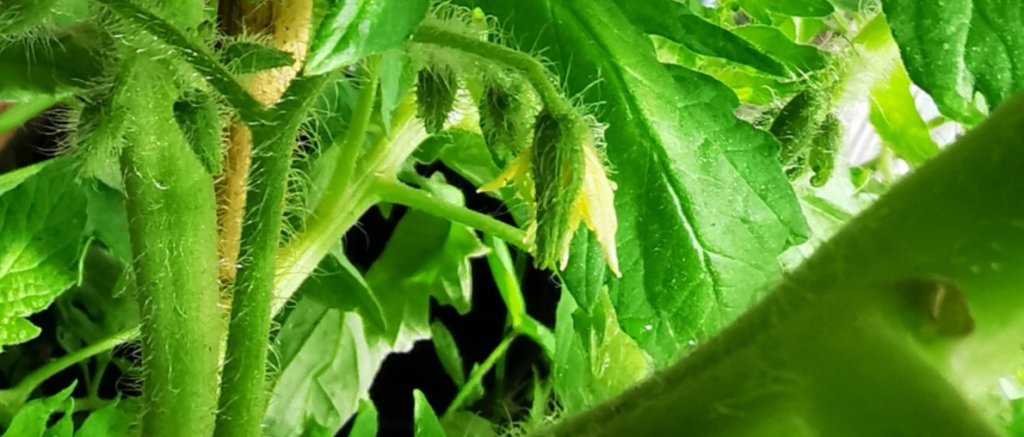
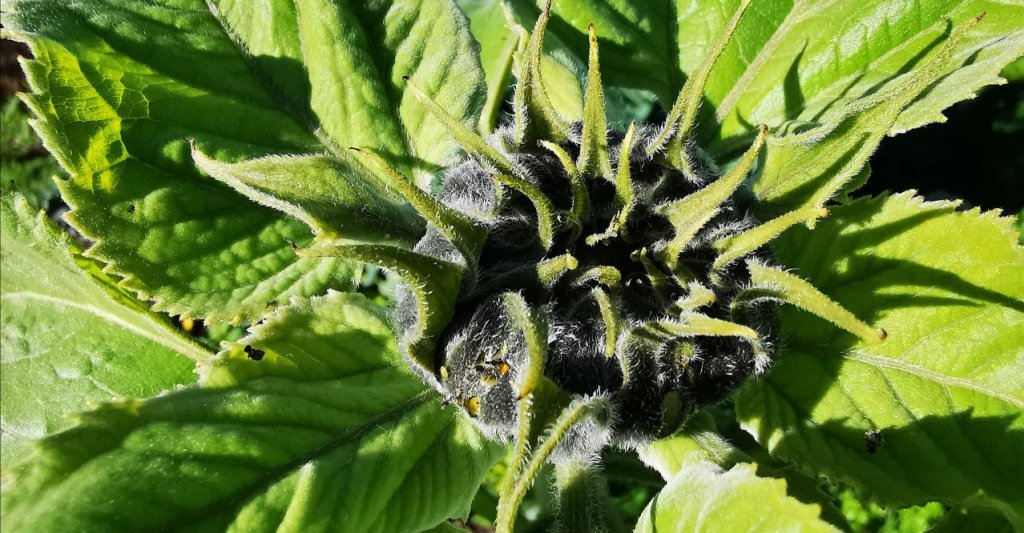
Most plants in the vege garden respond to these changing sunlight hours and have nighttime length triggers (a photoreceptor protein) that determines when they bloom. Some are short-day plants, and some are long-day plants, but there is a small number that are day-neutral. This means the length of the day and night has no effect on when they bloom and fruit. I am yet to find a definitive and comprehensive list of these, but cucumbers, tomatoes, corn, and sunflowers are on it. This explains why, now in mid-winter, I have a thriving and flowering tomato plant. It self-seeded sometime in the autumn and is growing behind glass designed to shelter a baby black passionfruit plant positioned in a sunny spot on our sheltered deck. I am wondering if it will fruit, or will a cold spell kill it? There is also a stray sunflower plant, self-sown from the summer ones, in the vege garden that is budding up. It has grown high it might escape the worst of the frosts. I expect as our climate warms, we will see more of these day neutral but temperature sensitive plants thriving through the winter months.

 food ripe from my garden