In folk-lore, parsley has a long history of magical properties. In medieval Europe, where it was believed only the wicked could grow it, parsley was associated with death and was used to decorate graves. Many types of bad luck are associated with transplanting it. In most of Europe it is believed it foretells a death in the family, here in New Zealand I have always been told that if a woman of childbearing age transplants parsley she will fall pregnant. There are many connections in folklore between women, fertility, power and death. It is said a woman will fall pregnant if it grows in profusion in her garden, that it will only grow in a household where the woman is boss and that she should plant it on good Friday, or in other variants, when the church bells are ringing. Once, female children were told they came from the parsley patch (and boys from the gooseberry bush). The parsley was thought to be representative of a women’s genitalia and pubic hair. Aristotle claimed that a linen cloth dipped in parsley juice then placed in the mouth of the womb will bring on a miscarriage, and witches of old believed eating parsley three times a day for three weeks would do the same. Some believe that putting a parsley spring up your vagina will bring on your period, or induce a miscarriage – as recently as 2018 an Argentinian woman died from septic shock after trying this out. Throughout the middle ages ‘Parsley Lanes’ were where the prostitutes hung out.
There is science that backs up some of these superstitions. Apiol, the essential oil made from parsley, was sold by pharmaceuticals in the first half of the 20th century as an aid to induce abortions. Sadly, it also induced nephritis and too many women overdosed and died.
The word parsley is derived from the Greek petraselinon, meaning rock celery. Parsley is in the same umbellifer family as celery, parsnip and carrot. The French call it persil and Germans still use the old English word die Pertersilie.
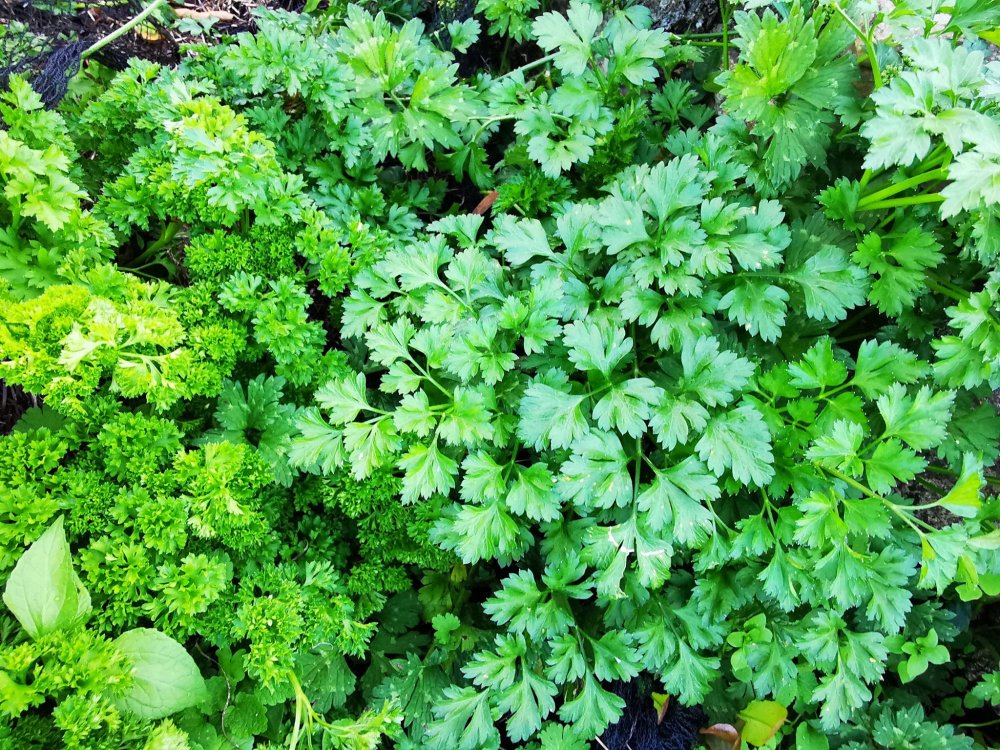
It is called a biennial plant, one that takes two years to complete its biological life cycle, although in my garden it has always been an annual which flowers and runs to seed in spring. There are several varieties I have collected over the years from curly leaf to the broad flat leaf with many in between. During spring and early summer each of these varieties flower at slightly different times so there is always some to pick, even if it is by rummaging around the base of a lanky gone-to seed-plant, to get enough parsley for the new potatoes. Eventually the seeds fall, germinate and grow again.
Now, in autumn, the next generation is lush, plentiful and ready.

 food ripe from my garden
A fascinating read. All my parsely has gone to seed. The full extent of the symbolism behind that?! 😊
Elda Heywood
LikeLike
Oh golly Elda… running to seed? But wait! Have a rummage around there will be new ones growing…..
LikeLike